The story
Our Mission at SA Water Innovation
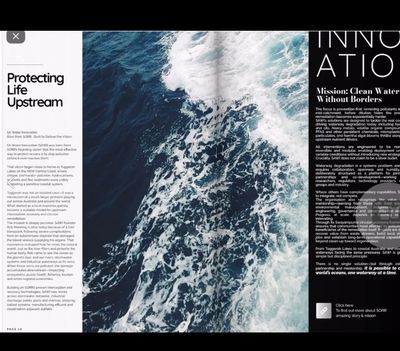
Protecting Life Upstream
SA Water Innovation - Built to Deliver the Vision.
SA Water Innovation (SAWI) was born from Rob's founding vision: that the most effective way to protect oceans is to stop pollution before it ever reaches them.
That vision began close to home at Tuggerah Lakes on the NSW Central Coast, where chronic stormwater pollution, hydrocarbons, nutrients and fine sediments were visibly degrading a sensitive coastal system.
Tuggerah was not an isolated case—it was a microcosm of a much larger problem playing out across Australia and around the world. What started as a local response quickly became a scalable model for upstream interception, recovery and circular remediation. The mission is deeply personal. SAWI founder Rob Manning is alive today because of a liver transplant, following severe complications from an autoimmune disorder that damaged the blood vessels supplying his organs. That experience reshaped how he views the natural world. Just as the liver filters and protects the human body, Rob came to see the oceans as the planet’s liver, and our rivers, stormwater systems and industrial waterways as its veins. When those veins are polluted, the damage accumulates downstream—impacting ecosystems, public health, fisheries, tourism and entire regional economies.
Building on proven interception and recovery technologies, SAWI now works across stormwater networks, industrial discharge points, ports and marinas, shipping ballast systems, manufacturing effluent and desalination-adjacent outfalls.
INNOVATION
Mission: Clean Water Without Borders
The focus is prevention-first: removing pollutants at mid-catchment, before dilution hides them and remediation becomes exponentially harder. SAWI’s solutions are designed to tackle the real culprits: hydrocarbons, degraded today, including heavy metals, volatile organic compounds, PFAS and other persistent chemicals, microplastics, nutrients, and harmful algal blooms (HABs) along upstream nutrient drives.
All interventions are engineered to be non-invasive and modular, enabling deployment under variable conditions without introducing new ecological risks. Crucially, SAWI does not claim to be a silver bullet.
Waterway degradation is a systems problem, and requires collaboration, openness and humility across industry, government, research and communities. SAWI is structured as a platform—working with partners, regulators, technology providers and industry.
Where others have complementary capabilities, SAWI seeks to integrate, not compete. The organisation recognises that value is created through learning, not ownership. It is built on principles of engineering, governance and community-led progress.
Through its Swayampurna circular-economy framework, SAWI ensures that every captured pollutant becomes a managed liability, not a hidden cost. Projects are designed to deliver immediate environmental benefit, build local skills and jobs, and establish long-term operational capability beyond clean-up toward regeneration.
From Tuggerah Lakes to coastal Australia, and now waterways facing the same pressures, SAWI is driven by a simple but disciplined principle:
There is no single solution—but through collaboration, partnership and mentorship, it is possible to clean the world’s oceans, one waterway at a time.
News from SA Water Innovation
MIKE STEER FIVE AA - 12 December 2025
MIKE STEER FIVE AA - 12 December 2025
MIKE STEER FIVE AA - 12 December 2025
Mike Explains that SA is “not out of the woods“ but
FIVE AA Interview 2/12/2025
MIKE STEER FIVE AA - 12 December 2025
MIKE STEER FIVE AA - 12 December 2025
On 21 December, Rob Manning appeared on FIVEaa with Sam Daddow to discuss the official launch of SA Water Innovations, outlining how the initiative will help South Australia tackle stormwater pollution, improve coastal water quality, and reduce the risk of harmful algal blooms. During the interview, Rob highlighted the state’s leadership in deploying advanced Gyroid filtration technology, the circular-economy approach ensuring no landfill and no incineration, and the importance of working collaboratively with councils, agencies and community groups to restore the health and resilience of Gulf St Vincent.
ABC interview - Statewide Soapbox Dec 2025
Our founder explains the challenge on ABC Radio Adelaide
How SA Water Innovation Wants to Approach This Challenge

SA Water Innovation’s approach is built on one principle:
Stop the pollutants and nutrient loads that feed blooms like Karenia before they reach the Gulf.
1. Shift South Australia from “reaction” to “prevention”
Right now, responses to Karenia blooms happen after the damage is done.
SA Water Innovation aims to flip this by introducing preventative systems at stormwater outfalls, intercepting the particles, nutrients, hydrocarbons and microplastics that fuel harmful algal growth.
2. Deploy proven filtration using the SAWI Gyroid material
Using the Gyroid and PAGE™ methodology, SA Water Innovation will:
- capture nutrient-rich sediments and organic particles,
- remove hydrocarbons, PFAS, microplastics and heavy metals,
- reduce the “food source” that blooms like Karenia depend on.
SARDI’s independent testing has already shown significant interception of algal particulates, including results of >96% removal of particulate-bound pollutants under specific test conditions.
3. Map and diagnose the stormwater system to find the biggest contributors
Instead of guessing where the pollution is coming from, SA Water Innovation will:
- install diagnostic filters (“socks”) across key stormwater outfalls,
- identify the hotspots and pollutant profiles,
- build a pollutant inflow map of metropolitan Adelaide.
This gives councils and the state hard data — not assumptions — on where the worst inflows are occurring.
4. Build a coordinated prevention program across councils
The approach includes:
- a unified, SMA-aligned monitoring framework,
- consistent deployment standards,
- shared reporting and data,
- and a single program that reduces duplication and gets faster results.
This stops the current “each council on its own” model and creates a state wide prevention network.
5. Apply a full circular-economy model (no landfill, no incineration)
Everything captured is:
- processed,
- sorted,
- and converted into usable construction-grade materials.
SA Water Innovation ensures:
- zero waste,
- zero landfill,
- zero incineration,
- new local manufacturing jobs.
6. Establish a South Australian Centre of Excellence
The long-term plan is to build a world-leading prevention and water-quality innovation hub in Adelaide, focused on:
- applied science
- stormwater engineering
- pollution diagnostics
- circular-economy processing
- export-ready manufacturing
- training and workforce development
South Australia becomes not just a user of technology — but a global exporter of knowledge, materials and systems.
7. Build resilience so blooms like Karenia become less likely
By reducing the stormwater-driven nutrient loads and sediment that fuel blooms, SA can:
- lower the frequency of harmful blooms,
- reduce their severity,
- protect marine habitats and aquaculture,
- and maintain safer, cleaner coastlines. and stormwater systems to minimise harm to the environment.